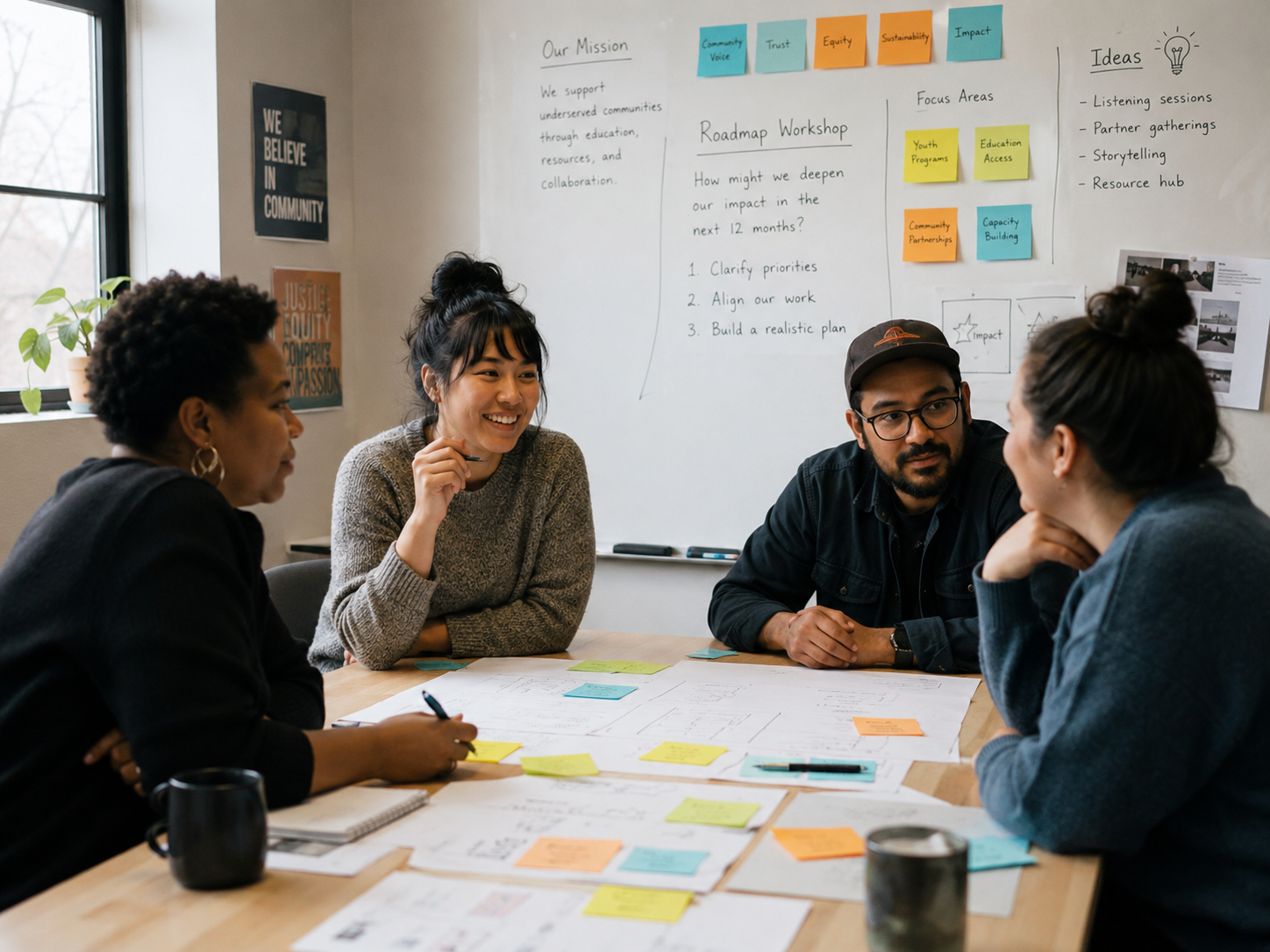
The most expensive part of building software is building the wrong thing.
Custom software is a significant investment — and the biggest risk isn't the vendor or the budget. It's starting before you know what to build. The Roadmap Workshop gives you validated research, stakeholder alignment, and a clear plan ready to execute. It also gives you the documented evidence to make the case internally and move forward with confidence.
The problem
Most software projects get the expensive part backwards.
Teams spend months in development only to discover that the thing they built doesn't quite match what their users needed — or that the internal team wasn't aligned on what "success" meant in the first place. By then, the budget is spent and pivoting is painful. It's penny-wise and pound-foolish, and it happens more often than anyone likes to admit.
Internal misalignment is expensive
Different stakeholders often have different ideas of what success looks like. Misalignment caught early costs a conversation. Caught during development, it costs months.
Rebuilding is the most expensive path
Software built on a shaky foundation usually needs to be redone. A few weeks of rigor upfront is far cheaper than starting over six months in.
Assumptions baked in from day one
Every team has assumptions about what users need. The further into development those assumptions go untested, the more they cost to correct.
“We knew we needed something custom. We just didn't know how to explain what we actually needed — or whether we were even asking for the right thing.”
Scope without strategy drifts
Without a prioritized plan tied to real evidence, feature lists expand, timelines slip, and the original goal gets buried under competing requests.
“We were nervous about committing to a large development contract without a clear picture of what we'd get at the end.”
The specific risks of going custom without a plan
- Building the wrong feature set — requirements driven by internal assumptions, not user research
- Ongoing maintenance and support costs that weren't budgeted (typically 15–20% of the build cost, annually)
- Scope that expands mid-development as stakeholders surface requirements that weren't captured upfront
- A tool that gets adopted but never used the way it was intended
- A better off-the-shelf solution that existed all along — discovered after you've committed to a custom build
- Technology decisions that become expensive and difficult to change over time
These risks don't disappear by choosing a good development partner. They appear before the first conversation — in the assumptions no one has examined yet.
What it is
Two weeks of active work to get it right before you build.
The Roadmap Workshop is a structured, facilitated engagement that takes you from "we think we need custom software" to a validated, prioritized plan your team is aligned on — and that a development team can execute without guessing. Two weeks of rigor before months of commitment. The organizations that move fastest in software aren't the ones who start building immediately. They're the ones who know exactly what they're building before they start.
Without the workshop
- Internal assumptions drive scope
- Stakeholders discover misalignment mid-build
- Feature lists grow without evidence
- Development starts before the plan is validated
With the workshop
- Real user research shapes priorities
- Team alignment before any code is written
- Evidence-backed roadmap your team owns
- Clear Phase 1 scope ready to execute
The process
How the engagement unfolds.
Every phase is structured and time-boxed. You'll know what's happening and why, and you won't get stuck in an open-ended discovery process that drags on indefinitely.
Pre-kickoff alignment call
Before anything starts, we spend 30–45 minutes getting oriented: your organization, your goals, your current tools, and what you're hoping to walk away with. We confirm who the key stakeholders are, agree on research responsibilities, and make sure the timeline works for your team.
By the end of this call, the kickoff is scheduled, the agreement is signed, and both sides know exactly what's coming next.
Kickoff workshop (90 minutes)
We bring your key stakeholders together — typically 5–7 people — for a facilitated 90-minute session. This isn't a status meeting or a requirements-gathering call. It's structured to do two things: align everyone on a shared vision of what success looks like, and surface the assumptions baked into that vision.
The cover story exercise
"Imagine it's two years from now and you're on the cover of a major publication. What's the headline? What does your happiest customer say about you?" This exercise reveals the real ambitions and values behind the project — and surfaces where your team agrees and where they don't.
User and stakeholder interviews
We conduct up to five interviews with your actual users or key stakeholders — the people who will live inside this software. These are 45-minute conversations focused on understanding their real needs, pain points, and workflows.
This is what separates a roadmap built on evidence from one built on guesswork. The insights from these interviews become the foundation for everything that follows.
Prioritization workshop
We synthesize the interview findings into 3–5 key opportunity themes and bring them back to your team in a focused working session. Together, we map each opportunity against two dimensions: how strongly it aligns to your vision, and how confident we are in the evidence behind it.
The alignment & confidence matrix
Opportunities fall into four zones: build now, prototype and test, build as capacity allows, or deprioritize. By the end of the session, your team has made the call — not us. It's your informed decision, grounded in what your users actually told us.
Final delivery
We synthesize everything — vision, research, prioritization — into your complete Roadmap Package and walk your team through it in a 30–45 minute readout session. You'll see the full story: where you started, what you learned, and the clear path forward.
If you're ready to move into development, this is also when we present a Phase 1 proposal with a defined scope, timeline, and cost estimate.
Deliverables
What you walk away with.
The Roadmap Package is four artifacts designed to give you two things: a clear picture of what to build, and everything you need to go back to your organization with confidence. Whether you're getting buy-in from leadership, aligning your board, or evaluating development partners — these deliverables do the heavy lifting internally so you're not selling an idea, you're presenting evidence.
The Story
Slides recapping your cover story vision alongside key research themes, each anchored in direct quotes from your users. Shows the arc from ambition to evidence. This is also your internal pitch deck — everything leadership, boards, or executive stakeholders need to understand what you're committing to and why.
The Plan
A one-page visual roadmap for the next 6–12 months, broken into Now, Next, and Later phases. Phased, achievable, and tied directly to the priorities your team agreed on.
The Concept
A first look mockup at what your software could become. Not a finished design, but enough to make the idea real and shareable with your team. The difference between reading a blueprint and seeing a rendering.
The Scope
A Statement of Work or proposal for Phase 1 only — right-sized, clearly scoped, with defined outcomes, team, and timeline. Gives procurement and finance teams something concrete to evaluate. No more open-ended conversations about what "custom software" will cost.
“The tool itself is a great success, but the process we followed — and the proof to ourselves that we can do it — is almost equally as impactful.”
What to expect
What we bring. What we'll need from you.
The workshop is collaborative by design. We run the process and do the heavy lifting — but we need access to the right people and honest answers to real questions.
What Fabrik brings
-
A dedicated strategist who runs every session and owns the process end to end
-
Structured facilitation for the kickoff, interviews, and prioritization workshop
-
User recruitment support if you need help reaching interview participants
-
Full synthesis of interview findings into clear, actionable themes
-
All documentation and the complete Roadmap Package deliverables
-
An honest build-vs-buy perspective — we'll tell you if you don't need to build
What we'll need from you
-
5–7 key stakeholders available for the 90-minute kickoff workshop
-
Access to 3–5 users or stakeholders for 45-minute research interviews
-
A primary point of contact who can coordinate internally and make decisions
-
Candid feedback about what's not working and where your team has different opinions
-
Any existing documentation: process maps, prior research, vendor proposals
-
About 6–10 hours of your team's time spread across three weeks
Investment
Simple, fixed-fee pricing.
No hourly billing, no scope creep on the workshop itself. You know exactly what you're paying before we start.
Starting at
Optional add-ons
The Concept — medium-fidelity mockups · The Scope — Phase 1 SOW. Discussed during the pre-kickoff call.
Larger or more complex engagements may be priced above $7,000 — we'll be clear about that upfront.
Common questions
A few things people usually ask.
No. Everything we produce belongs to you. You can take the Roadmap Package to any development partner — or use it to have a much more informed conversation with developers you already have in mind. We'd love to continue, but there's no obligation.
The most common: building the wrong feature set because requirements were based on internal assumptions, not user research. Beyond that — underestimating ongoing maintenance costs (typically 15–20% of the build cost annually), scope that expands mid-development, a tool that gets adopted but never used the way it was intended, and sometimes discovering a better off-the-shelf solution after you've already committed to a custom build. The workshop doesn't eliminate all risk. But it surfaces the known ones early, when they're still cheap to address.
We'll tell you. Part of our role is honest framing — and we've told clients that an off-the-shelf tool was the right answer. The goal is for you to leave with the right decision, not to generate a development engagement we can bill.
Maybe not the full workshop. If you have a clear, detailed, stakeholder-aligned scope document, we can review it and discuss whether a lighter validation pass makes more sense. Most teams, even those with solid documentation, find the user interviews surface things that weren't captured on paper.
We offer three levels of support: you handle all recruiting, we handle outreach on your behalf, or we recruit participants externally through a professional research panel. We'll confirm the right approach during the pre-kickoff call based on your situation.
Often yes. Capacity-building grants and technology funds frequently cover strategy and discovery work. We're happy to provide documentation that supports a grant application or funder report.
Not sure if you're ready?
That's exactly when to talk.
We'll spend an hour understanding what you're working on and give you an honest take on whether the Roadmap Workshop is the right next step. Not ready for a call? Start with the free Build vs. Buy Assessment — five minutes, no commitment.