Ed-Tech
The Ceiling You See Coming Is the One Worth Fixing
How Fabrik Labs helped The Autism Helper level up to stay ahead of their competition.
They weren't in trouble. That was the whole point.
The Autism Helper had built something real. A platform sold directly to school districts, giving special education teachers access to structured, ready-to-use curriculum materials for students with autism. Sasha Long and her team had developed a genuine market position. Districts were renewing. Teachers were relying on the product.
By most measures, things were going well.
But Sasha could read the room. Bigger districts — the ones worth winning — were coming with longer procurement checklists: security requirements, accessibility compliance standards, IT compatibility expectations that a WordPress and WooCommerce setup simply wasn't built to meet. The competition wasn't standing still. And the internal team was spending more and more time supporting existing customers rather than building toward what came next.
"The most limiting factor was we didn't have a lot of growth opportunities for it," Sasha says. "We had a lot of big plans and big ideas."
This is the hardest kind of decision to make — the one you make from a position of strength rather than desperation. It's easy to rebuild when you have no choice. It's harder when things are working, when the cost of change is real, and when you're the one who has to convince yourself the ceiling is real before anyone else can see it.
Sasha saw it and decided to move before she had to.
The gap the old platform couldn't close
The WordPress setup had served its purpose. But it had calcified around The Autism Helper's earliest assumptions about what the product needed to be, and the gap between what it was and what the team needed it to become was widening every month.
Content updates required pulling in developers for changes that should have taken minutes. Adding new features meant negotiating with infrastructure that hadn't been designed for growth. For teachers already operating under significant time pressure, the navigation had become a maze. "It was a lot of layers of pages and hard to find things," Sasha says.
One of the most glaring gaps was print. Building custom workbooks from specific lessons and printing only those is a fundamental part of how most special education teachers work. The old platform simply didn't support it. Teachers had found their own workarounds, but the absence was felt.
Fabrik needed to understand the ecosystem as much as the technical debt. Special education is a specific world with specific constraints — IEP timelines, paraprofessional workflows, district compliance requirements, the reality of how teachers actually use materials in self-contained classrooms. The platform had to work for that world, not just for a generic SaaS use case.
"We have a very niche product and a niche brand," Sasha says, "but the team jumped right in to understand the intricacies of our platform."
Building the right thing before building everything
The instinct when you've been waiting to rebuild is to build everything at once — to finally fix all of it, get every feature right, launch something that's 100% complete. Sasha wanted that. It turned out to be the better call.
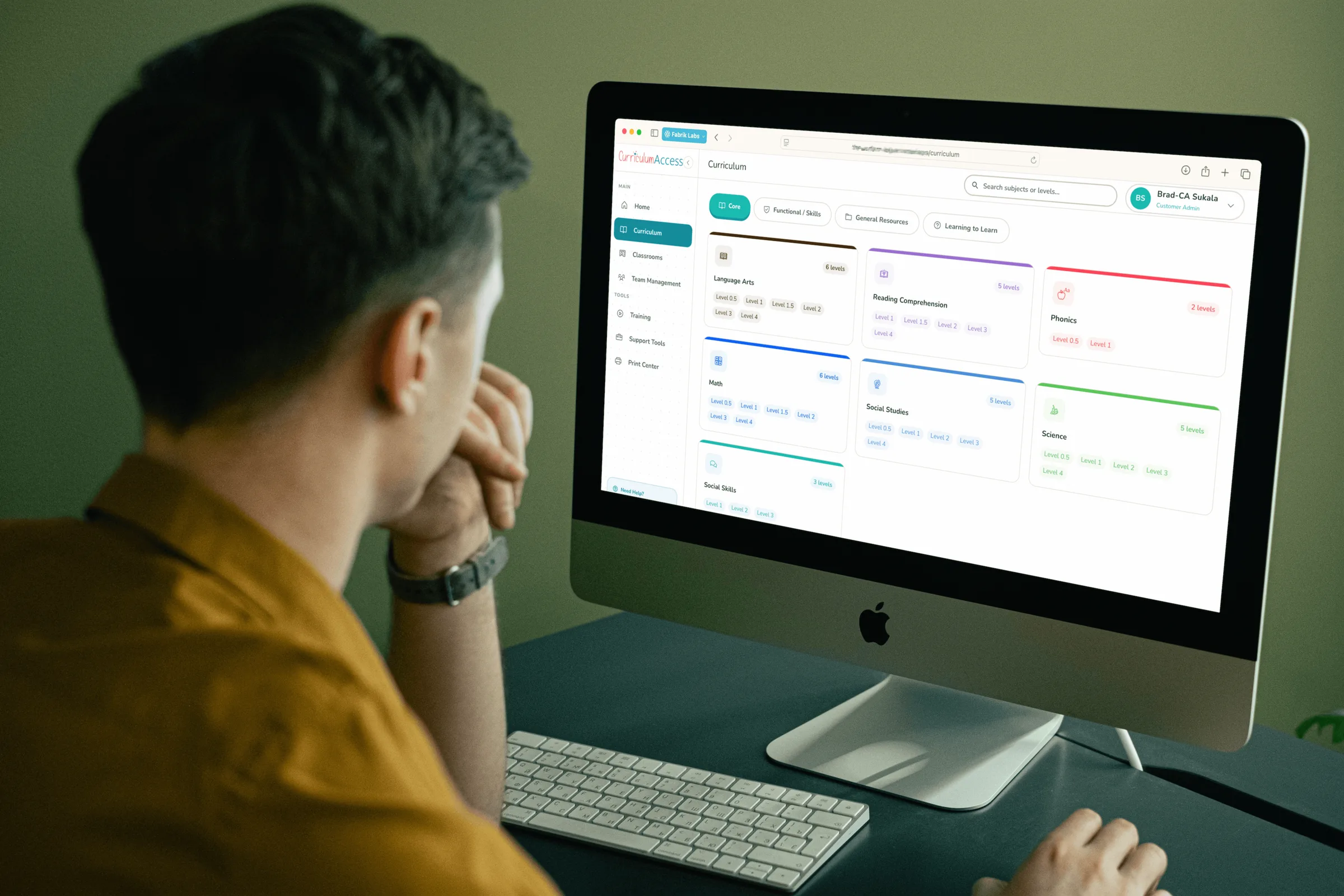
Fabrik's approach was to build an MVP that mirrored what users already knew, familiar enough to adopt yet meaningfully better, then learn from actual use before committing to the full product vision. The new platform launched with enhanced back-end account management (so Sasha's team could update content without developers), self-service sign-up and payment flows, the rebuilt print feature, a navigation overhaul, and digital assessments as a new capability.
The stewardship didn't stop at launch. Fabrik kept a team in place through the first full school year — the period when you find out what no spec document could have told you.
How they worked together mattered as much as what they built. Sasha is clear that she doesn't have a technical background. What she found wasn't a team that nodded and built whatever she asked for. "There's always been a nice open line of explaining why things can work or shouldn't and a lot of back and forth — not just 'Hey, this is what I want,' and build it, because that might not make sense," she says.
What living in the platform revealed
The MVP shipped. Teachers started using it. What they found drove the work that came next.
"We didn't know what we didn't know," Sasha says. "And now we know these things and we know what changes to make. Whereas if we had built everything from the start, we probably wouldn't have done things the most optimal way."
The navigation overhaul eliminated what had been one of the most consistent user complaints — the experience of not being able to find things. Load times dropped fivefold. Renewal workflows that had required dozens of manual steps now ran in half the time across 450+ accounts. The back-end improvements meant Sasha's team could operate like a product team rather than a support queue. And the custom print feature users had been asking for shipped with the initial release.
The improvements that teachers surfaced in the first year shaped the roadmap for what came next in ways no upfront scoping session could have predicted. The shift in Sasha's priorities came from living with a real product, not from Fabrik telling her what to build.
“I thought this was a really great fit for my company because they understood our product really quickly.”
Where it stands today
The Autism Helper is now in its second phase of work — major feature enhancements, an interface redesign, and ongoing product development. The ceiling Sasha saw coming hasn't disappeared; it's raised. Larger districts, bigger compliance requirements, a competitive landscape that keeps moving. But the platform can move with it now.
The original platform is retired. The new one is the foundation. The relationship isn't project-based anymore — Fabrik remains an active partner in Phase 2, helping prioritize what gets built next based on user feedback, technical lift, and what delivers the most value.
“We have more ideas than time, but we've been able to build out a lot of these ideas.”
In their own words
Ready to build something you can actually grow into?
If you can see the ceiling before you've hit it, that's the right time to act. Let's talk about what the next version of your platform needs to do.