
Ed-Tech
Building with Purpose, Not Assumptions
How Fabrik Labs helped the Alliance for Decision Education turn a hypothesis into a working AI tool — and a new way of thinking about teacher adoption.
The real problem wasn't content. It was the last mile.
The Alliance for Decision Education has spent years developing high-quality materials to help K-12 teachers bring decision-making skills into their classrooms. The content exists. The research backs it. The mission is clear — to improve lives by empowering students with essential skills and dispositions for making better decisions.
But adoption has always been the harder problem.
Schools license supplementary programs every year. Most of them sit unused — not because teachers don't care, but because they're already stretched to the limit managing existing curriculum demands and the realities of modern classrooms. Asking them to then figure out how to weave a new framework into their existing lesson plans, on their own, is usually a bridge too far.
The Alliance understood this. What they didn't yet know was whether technology could close that gap.
A hypothesis worth testing — honestly
When the Alliance came to Fabrik, they weren't arriving with a spec sheet. They were arriving with intellectual humility about what they didn't know.
Their starting position:
“We are beginning with a hypothesis that AI might help us embed Decision Education within schools’ existing curriculum. We do not know yet if that is true. We are open to learning that it is not.”
That kind of clarity about uncertainty is rare — and it shaped everything about how the engagement ran. This wasn't a build project. It was a discovery and validation project that might become a build project.
This is where a lot of development partners would have jumped straight to scoping. Fabrik's instinct was the opposite: slow down, stay in the problem longer, and resist the pull toward solutions until the right direction became clear. That discipline — treating discovery as real work, not a formality before the “real” work begins — is what made the difference between building something and building the right thing.
The insight that changed the direction
Early in discovery, a possibility emerged: AI could handle the heavy lifting of curriculum integration for time-pressed teachers.
Not a foregone conclusion. Not something the Alliance had assumed going in. But a hypothesis worth proving out — and quickly.
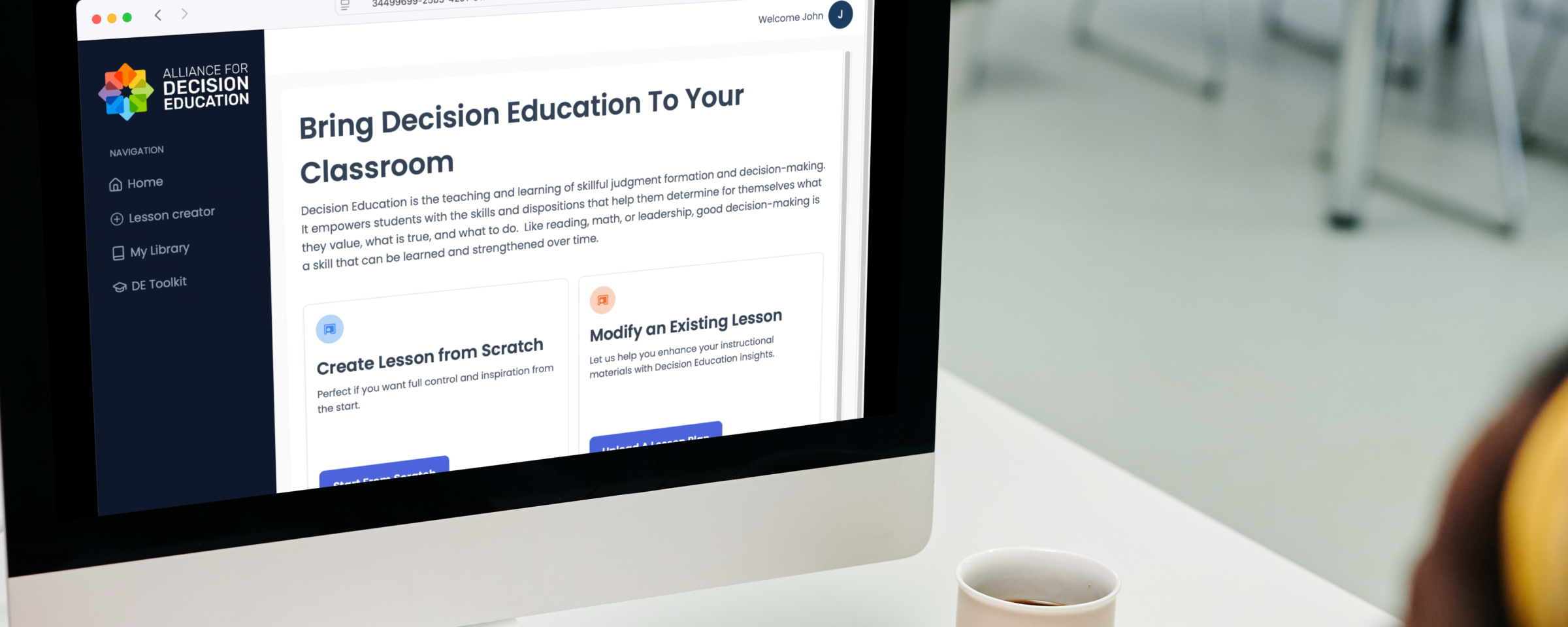
Fabrik built a proof of concept. The mechanism was straightforward but the impact wasn't: a teacher uploads their existing lesson plan. They indicate their grade level, available time, and the decision education topic they want to address. The tool returns their original lesson plan — structure intact — with Decision Education content woven directly into it, matched to what they're already teaching.
The teacher's work doesn't get replaced. It gets enhanced.
“If I wanted to build anything around DE I would use this tool….”
What early testing revealed
The Alliance brought the prototype to real teachers. The core value proposition landed: they responded well to the tone — helpful, explanatory, giving context before giving advice rather than just dropping content into their plans. It felt like a knowledgeable colleague, not a content dump.
The concerns that surfaced were refinement problems, not fundamental objections: better controls for politically sensitive topics, more depth on the Decision Education content itself, improved overall usability. The kind of feedback that tells you the foundation is sound and the work ahead is real.
Where it stands today
Decision Studio is now in its second phase of development, actively shaped by what the first prototype revealed. The current work focuses on three things: resolving the usability concerns from v1, establishing role-specific features, and preparing for a structured fall pilot.
Whether it eventually becomes a market-facing product for teachers or remains an internal tool for the Alliance's team is still an open question — one they're answering deliberately, with real user data, rather than assumption.
That's the point. The Alliance came in knowing what they didn't know. Fabrik helped them build a way to find out.
“The tool itself is a great success, but the process we followed — and the proof to ourselves that we can do it — is almost equally as impactful.”
In their own words
Need adoption, not just software?
Let's design and validate the right solution before you build.