
A client once handed us a well-developed prototype of a health tracking feature, built in Lovable, an AI app builder. It wasn’t production-ready, but it was a good picture of what they were thinking. What it didn’t show was why anyone would use it.
That’s why our product roadmap template starts with the problem.
It opens with a one-page brief, then sorts your work into Now, Next, and Later. It’s free and it’s not gated. Make your own copy of the product roadmap template, or copy the fields further down into any doc.
Ready to try it? Make your own copy of the free Google Sheet.
Get the free roadmap templateThe prototype without a why
Our client came to us with an idea for a health tracking feature inside their larger app.
What was missing was a why for the user. Why would someone want to use this feature? What would they get out of it?
They didn’t have a great answer. It was an idea they thought would be cool. Their underlying goal was valid: help their audience make healthier food decisions. But the prototype went far beyond that, and even beyond what the client could support. You could log vital statistics like your weight and blood pressure. A feature they called “Health Connect” would link to hospital systems in the area, so users could share their eating habits and medical information with those providers.
We pushed on it. We explained what Health Connect would take, both technically and from a privacy standpoint, and we kept asking what users would get out of it. It became apparent that what they actually wanted was a way to encourage healthy eating habits, supported by the produce they were providing.
We used this to drive our own recommended version: scaled back, more achievable, and more focused.
In the end, the client decided not to build any of it. Other issues took their attention, but I also believe that our work helped them see that this wasn’t going to move the needle as they’d hoped.
That saved them money, because they didn’t spend it on a feature of questionable value. It also saved them focus. The energy they would have spent working with us to bring that feature to life could go somewhere else.
Why this roadmap template has no dates
Here’s an awkward situation you might be familiar with: a commitment that was a good idea six months ago, but now you’re not so sure. It’s got a date on it, and you promised it to people, so you don’t want to drop it.
Dates for work several steps down the road are rough guesses at best. When those dates slip, or the work behind them changes, it undermines the sense that the plan is worth anything. So our template has no dates column. It has three sections instead:
- Now is the thing you’re going to work on now. If that’s this week, fine. If it’s this quarter, also fine.
- Next is the one or maybe two things you’ll pick up after that. Think of it as a fuzzy date.
- Later is everything else. You’ve still got eyes on it.
Next and Later already have their place, so you can put them aside and get Now done. Then Next becomes Now. As you finish each piece, what’s next and what’s later may shift as you learn more. That’s how the product roadmap stays useful after the first session.
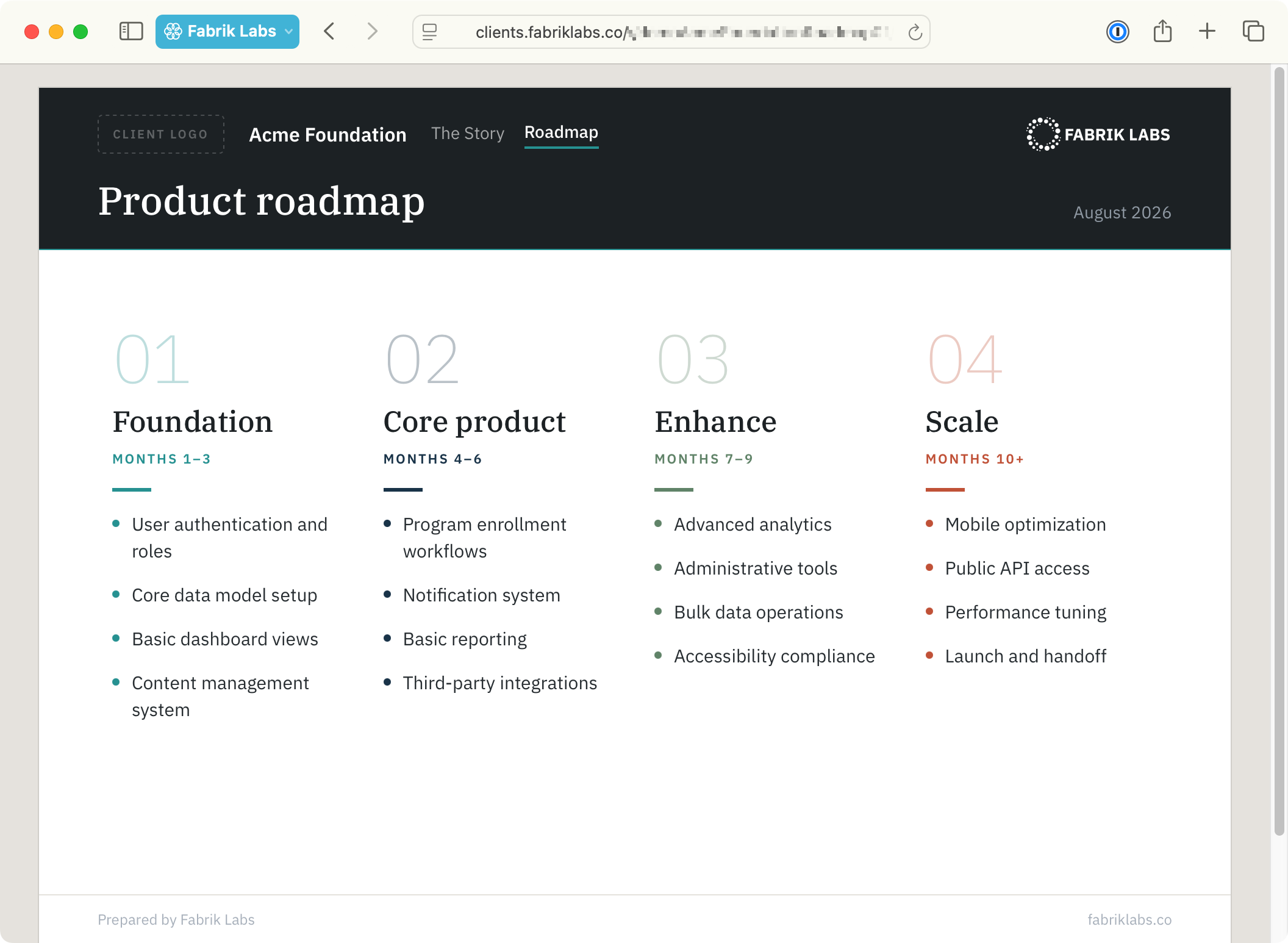
For more on how phases fit together, see What Is a Product Roadmap, and Why Do You Need One?
When the board asks, “When will this be done?”
Push back a little, and ask what “this” is. What you’re doing is addressing a problem, not building a specific thing. Each step gives you more information, and you better understand the issue and how to address it. Forecasting many months out, and saying you know the solution and how long it’ll take, is a little naive. Better to say, “This is the problem we’re solving. These are the steps we believe it’ll take to get there.” Then reevaluate after each step. You can offer to report on your progress on a regular basis.
The further you get down that path, the closer you can get to setting dates. Once you’re confident in the direction and your analysis hasn’t changed in a while, you can start to project it out. Early in roadmapping, there’s no value in a date. If they press, see if they’ll share why a date is critical as long as you’re showing regular progress.
Funding is the exception. If you’re asking for money, you need some sense of timeline so things don’t run on forever. In this case you can use fuzzy dates, like “This will be done in Q3.” Just don’t start there.
The product roadmap template
Before you list a single feature, write down the problems you’re solving. Get granular: name the root problem, and how each feature will contribute to solving it. When you start writing those things down, you tend to see the flaws in your thinking, or the gaps in implementation, quickly. Skip this step and you end up with features that don’t get used, one of the most common reasons custom software projects fail. If you’ve been wondering how to describe a software idea to a developer, this is where to start.
The examples below describe a made-up nonprofit whose quarterly funder report takes two people about two days to put together.
Step 1: The one-page brief
Think of it as a software project brief that fits on one page.
| Question | Example |
|---|---|
| What problem are we solving? (2–3 sentences) | Our quarterly funder report takes two people about two days to put together. The numbers live in three places, and we re-type them by hand. Mistakes slip through, and we sometimes find them after the report goes out. |
| Who is it for? (roles, rough headcount) | Program managers (4) who collect the data, our development director (1) who writes the report, and our executive director (1) who signs off. |
| What happens today? (the workaround) | Each program manager exports a spreadsheet and emails it to the development director, who copies the totals into a Word template. |
| What does success look like in 6 months? (things you could see happen, not features) | The report takes half a day. The numbers are right the first time. Program managers stop getting end-of-quarter data requests. |
| Constraints (deadlines, funder or board dates, systems we have to keep) | Next funder report is due March 31. The board meets in February. We have to keep our current CRM. |
| Who makes the final call? | Executive director, with input from the development director. |
| Open questions | Do all our funders want the same numbers? Who decides how each number is defined? How can leadership see progress between reports? |
Step 2: Break the big problem down
Your first answer is usually too big to start on. Ask: “What has to be true before this can be fixed?” Write the answer, then ask the same question about that answer. Stop when you reach something your team could start next week.
| Step | Example |
|---|---|
| The big problem | Our funder report takes two days to put together. |
| What has to be true first? | The numbers have to be entered once, not re-typed from three spreadsheets. |
| What has to be true first? | We have to agree on what each number means and who owns it. |
| Could we start this next week? | Yes. An hour with each program manager gets us there. That's our Now row. The answer above it is Next. |
Step 3: Your roadmap
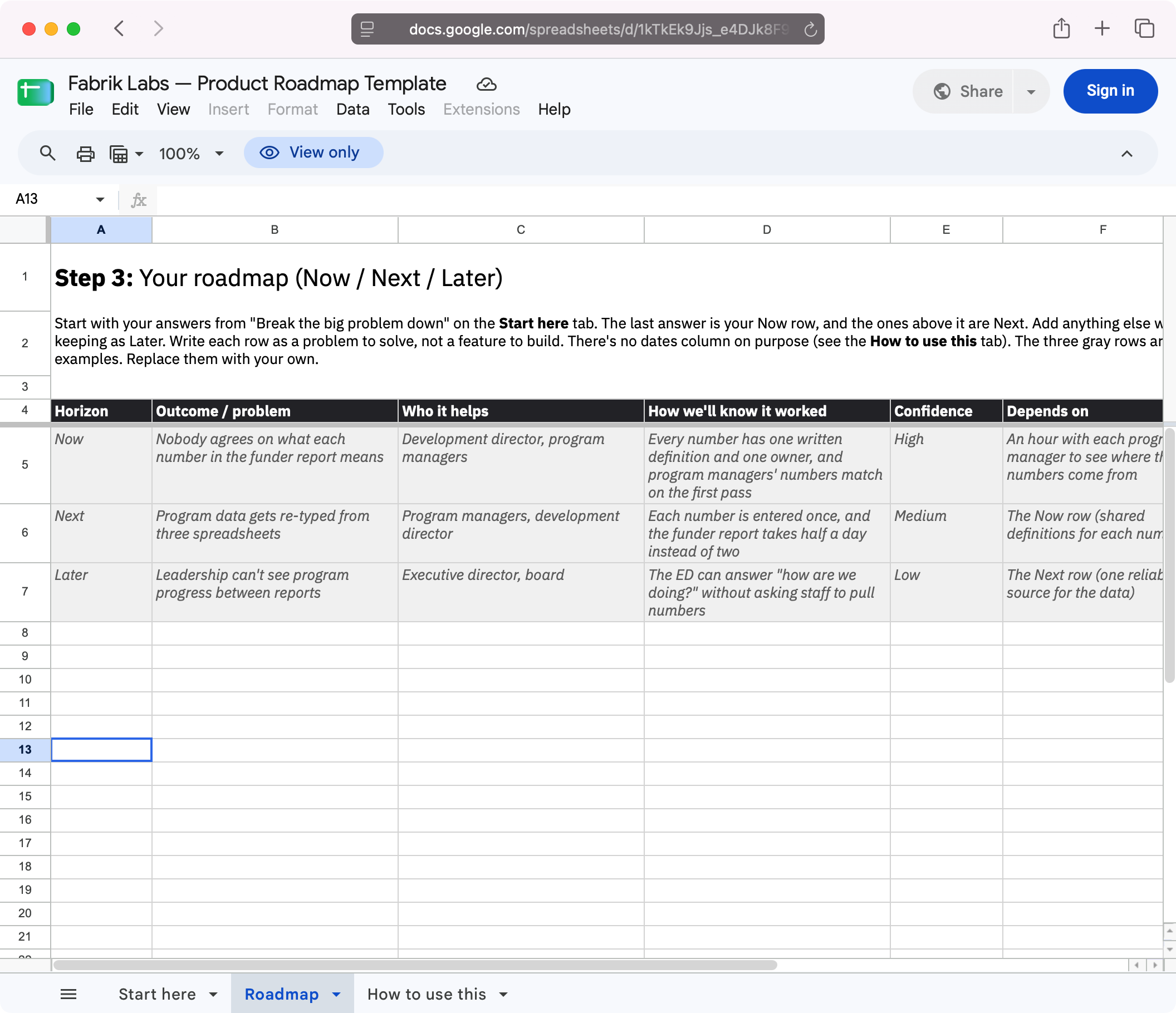
Write each row of the product roadmap as a problem to solve. Use the Confidence column honestly. Low confidence means you need to learn something before you commit time or money to that row.
| Horizon | Outcome / problem | Who it helps | How we'll know it worked | Confidence | Depends on | Owner | Notes |
|---|---|---|---|---|---|---|---|
| Now | Nobody agrees on what each number in the funder report means | Development director, program managers | Every number has one written definition and one owner, and program managers' numbers match on the first pass | High | An hour with each program manager | Development director | |
| Next | Program data gets re-typed from three spreadsheets | Program managers, development director | Each number is entered once, and the report takes half a day instead of two | Medium | The Now row | Operations lead | |
| Later | Leadership can't see program progress between reports | Executive director, board | The ED can answer "how are we doing?" without asking staff to pull numbers | Low | The Next row | Executive director |
How to use the product roadmap template this week
Do a dry run alone. Work through the template on your own, roughly, to understand how it works and get a sense of what your answers might be. Don’t bring that draft to the group, but use it to drive your facilitation of the working session.
Then start fresh, together. Open a clean copy with the primary stakeholders for whatever system you’re discussing. One person filling out a spreadsheet alone gives you a biased perspective, and it won’t build buy-in across your team. Bring in:
- Whoever owns the system itself from a technology perspective.
- Whoever owns the relationship with its users. For an internal system, that’s the manager of that department. For an external one, it’s whoever owns that service or that customer relationship.
- A user, if you can get one. For an internal system, invite one to the session. For an external audience, nominate someone on your team to represent that voice.
You don’t necessarily need an executive. Frontline managers often see the problem most directly, and they can use the roadmap to advocate for a change with leadership. An operations director, or someone at that level, might lead it.
Do all three steps in one session. Write the brief, break each problem down, and sort the results into Now, Next, and Later. If the person who did the dry run facilitates briskly, that’s about an hour. Two one-hour sessions wouldn’t be surprising either.
You should walk out with a clear list of what you’re working on right now, and a product roadmap you can keep updating.
When a template isn’t enough
After your team session, a few signs it’s time to bring someone in:
- You can’t agree on what belongs in Now…or even Next.
- You’re struggling to pin down the foundational problem. You’re guessing at it, and you need to talk to staff or users to be sure.
- There’s funding attached. You need to make the case for this direction to your board or funders, and you want it buttoned up.
For a small team with the time, and a small enough scale, I’d encourage you to do this yourself. Treat the template as a starting point to argue with, not a plan to build to the letter.
For other teams, it’s too big a task to take on with the time they have. When we do this at a larger scale, interviewing many individuals, it can generate 25, 30, or more themes. Pulling those out of individual comments, then boiling them back down into specific problems and features is a lot for someone who hasn’t done it before.
An outside person can also talk to different people and get more voices into the conversation. An objective third party can help you avoid groupthink and the organizational themes that keep you in the same rut.
If you still can’t name the problem, that’s where our Roadmap Workshop comes in. Remember, features without a problem driving them don’t get used. Whether you figure that out on your own or bring someone in to help, there isn’t a more critical step to ensure success.
No matter what, make sure you’re building for the user’s why.
Related posts
Planning a Software Project
What Is a Product Roadmap, and Why Do You Need One?
What a product roadmap is, why building in phases cuts rework and risk, and how to start from today. A plain-English guide for nonprofit and ed-tech leaders.

Planning a Software Project
The Vision Is the Deliverable
Speed without strategy leads to costly rework. A roadmap-first approach keeps custom software aligned to your business outcomes.
Planning a Software Project
How the Jobs to Be Done Framework Keeps Your Product Focused
Adding more features won’t make your app better. The Jobs to Be Done framework helps you build only what matters—and keeps your MVP focused.